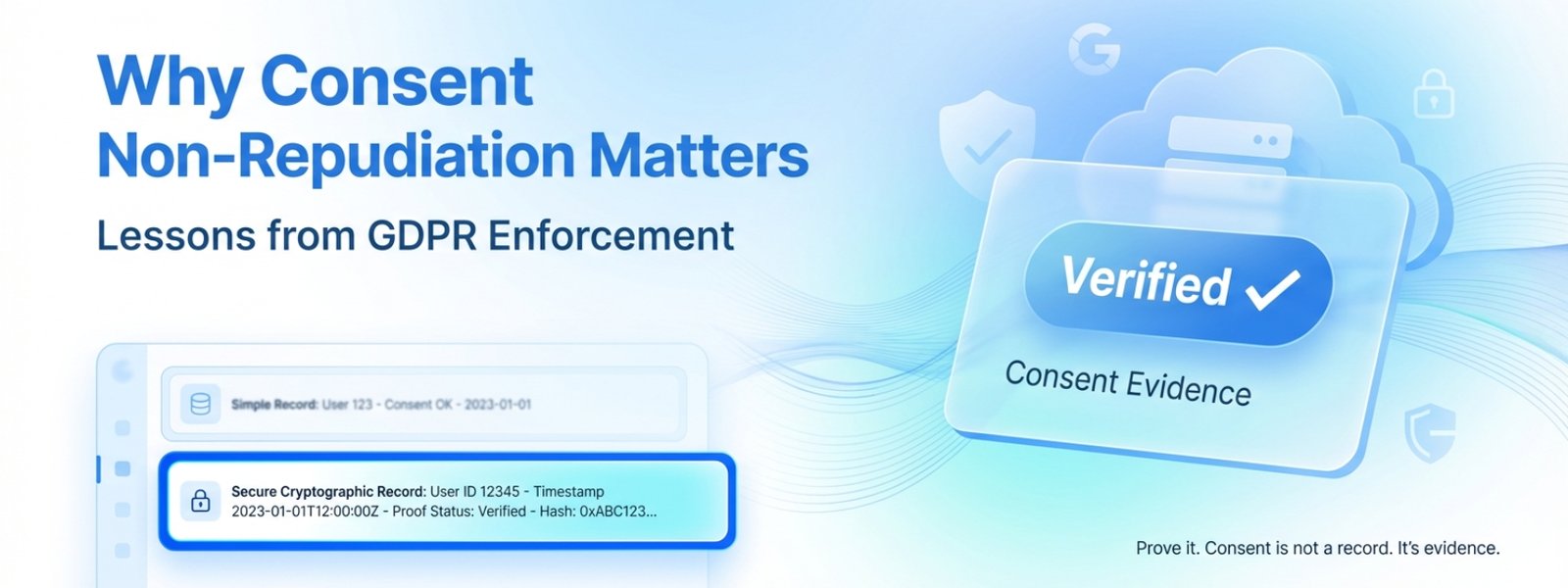
The Question That Changes Everything
Imagine the Data Protection Board of India contacts your organisation. A data principal has filed a complaint: "I never consented to receiving marketing emails. You have been processing my data without authorisation."
Your response: "We have a record showing this user granted consent on June 1, 2025."
The DPBI's follow-up: "Prove it."
What does your evidence look like? If the answer is a database row with a boolean flag and a timestamp — you have a problem. Not because you acted in bad faith. But because a database row is not proof. It is a claim. Under India's DPDP Act, as under Europe's GDPR, the burden of proof is on you.
What Non-Repudiation Means
Non-repudiation is a property of evidence that makes it impossible for one party to deny having taken an action. A non-repudiable consent record is one where:
- The identity of who gave consent is provable
- The exact terms of what was agreed to are preserved
- The timestamp of consent cannot have been backdated
- The record itself cannot have been altered since creation
- The organisation that created the record cannot deny creating it
Specifically, it requires the same mechanisms that make blockchain tamper-evident, digital signatures legally binding, and trusted timestamps court-admissible — applied to every consent event.
5 Lessons from GDPR Enforcement: What Regulators Actually Scrutinise
Europe's GDPR has been enforced since May 2018. Eight years of enforcement provide a detailed picture of what regulators look for — and what they find lacking.
"We Have a Consent Record" Is Not Enough
In 2023, the Irish Data Protection Commission investigated a major technology platform for alleged unlawful processing. The platform claimed it had consent for all processing. The investigation found:
- Consents were bundled — multiple processing purposes hidden within a single acceptance
- The consent interface used dark patterns — "agree" was prominent; "decline" required four additional clicks
- The consent records contained no snapshot of what the user was actually shown at the time of consent
- The company could not demonstrate that the notice version active at the time of consent matched what the user saw
Fine imposed: €1.2 billion.
India parallel: DPDP Act §6 requires consent to be "free, specific, informed, unconditional, and unambiguous." Each of those five adjectives is a separate evidentiary burden. The fact that your database says a user "agreed" does not prove their consent was any of these things.
Timestamp Manipulation Is a Real Concern
In several GDPR enforcement actions, regulators have questioned whether consent records were created contemporaneously with the actual consent decision — or whether records were created or modified retroactively when enforcement was anticipated.
The concern is not hypothetical. A database administrator with direct table access can insert a record with any timestamp. Application logs can be altered. Backup restoration can be used to create plausible deniability.
What regulators want: A consent timestamp issued by a party independent of the organisation — one whose clock cannot be manipulated by the Data Fiduciary. RFC 3161 Trusted Timestamp Authority (TSA) tokens are the technical standard. A TSA token from DigiCert or GlobalSign carries their certificate and can be verified by anyone without relying on the Data Fiduciary's systems.
The Text of What Was Shown Matters
Multiple GDPR enforcement actions have turned on what, exactly, the user was shown at the time of consent. Companies that could not produce the exact text — or that had updated their notice after consent was given without retaining the prior version — were unable to defend the validity of their consents.
What is required: A verbatim snapshot of the consent text shown to the user, captured at the moment of consent and stored immutably in the consent record. Storing only a reference to the current notice version is insufficient — the notice may have changed since the consent was given.
Withdrawal Must Leave a Trail
GDPR regulators have found that many organisations record consent withdrawal as an update to the consent record — overwriting the original consent. This destroys evidence of both the original consent and the withdrawal timeline.
What is required: An append-only consent ledger where withdrawal creates a new record (with its own hash, signature, and timestamp) linked to the original — not an overwrite. This preserves the full consent lifecycle and makes the timeline independently verifiable.
Downstream Propagation Is Non-Optional
Regulators have fined organisations not just for failing to maintain consent records — but for failing to propagate withdrawal decisions to downstream processors. A data principal withdraws consent for marketing; the organisation records the withdrawal; but the third-party ESP continues sending emails because the withdrawal was never communicated.
Under the DPDP Act, §8(7) requires erasure on withdrawal — and DPDP Rules Rule 4(5) requires a log of consent propagation. "We told our systems" is not sufficient; you must be able to demonstrate the delivery.
The Four Layers of Non-Repudiable Consent
Informed by GDPR enforcement patterns and the DPDP Act's specific requirements, Vishwaas AI implements consent non-repudiation through four interlocking technical layers.
Layer 1: SHA-256 Hash Chain
Every consent record is linked to the previous record in a cryptographic chain. The chain hash of record N depends on record N-1's chain hash. Any modification — however minor — breaks the chain from that point forward.
Record N-1:  chain_hash = SHA-256(record_N-1_hash + chain_hash_N-2)
Record N:    chain_hash = SHA-256(record_N_hash   + chain_hash_N-1)
                                                     ↑ depends on N-1
What this proves: Records cannot be inserted, deleted, or modified without breaking the chain. Ledger integrity can be verified by anyone with access to the records.
Layer 2: RSA-2048 Digital Signature
Each consent record is signed with the Data Fiduciary's RSA-2048 private key, held in AWS KMS (Hardware Security Module). The private key never leaves the HSM.
digital_signature = RSA-SHA256-Sign(record_hash, kms_key_arn)What this proves: Only the holder of this tenant's KMS key could have created this record. The organisation cannot deny creating it. Any alteration invalidates the signature.
Layer 3: RFC 3161 Timestamp Authority Token
A third-party Timestamp Authority (TSA) — DigiCert or GlobalSign — issues a cryptographically signed token that binds the consent record hash to an independently verified timestamp.
What this proves: The consent record existed at the stated time. The timestamp cannot have been backdated — the TSA's clock is independent of the Data Fiduciary's infrastructure. A DPBI investigator can verify the TSA token directly with DigiCert without involving Vishwaas AI or the Data Fiduciary.
Layer 4: DB-Level Append-Only Enforcement
The application database role is granted only INSERT and SELECT on the consent records table — UPDATE and DELETE are explicitly revoked at the PostgreSQL database layer.
REVOKE UPDATE, DELETE ON consent_records FROM crosstrust_app;
GRANT  INSERT, SELECT  ON consent_records TO   crosstrust_app;
What this proves: Even a compromised application cannot alter or delete consent records. Tampering requires direct database superuser access, which is separately controlled and logged.
The Consent Text Snapshot: Closing the "What Did They Agree To?" Gap
GDPR enforcement has repeatedly shown that consent records without a snapshot of the exact text are vulnerable. Vishwaas AI closes this gap with the consent_text_snapshot field — captured at the moment of consent in every language the user was shown:
{
  "consent_text_snapshot": {
    "en": "I agree that Acme Corporation may use my email address for marketing
           communications. I can withdraw this consent at any time via the Acme
           privacy portal.",
    "hi": "मैं सहमत हूँ कि Acme Corporation मेरे ईमेल पते का उपयोग मार्केटिंग
           संचार के लिए कर सकती है। मैं इस सहमति को किसी भी समय वापस ले सकता हूँ।"
  },
  "notice_version_id":    "ntc_01HX...",
  "notice_content_hash":  "a3f9b2..."
}
The notice_content_hash is the SHA-256 hash of the notice version active at the time of consent. Any subsequent modification to the notice does not affect the snapshot — the record preserves exactly what the user saw.
What Non-Repudiation Looks Like to a DPBI Inspector
When a DPBI inspector requests evidence that a specific data principal's marketing consent was validly obtained, a Vishwaas AI customer can produce:
| Question | Answer | Evidence Type |
|---|---|---|
| Did this person consent? | Yes — record cns_01HX... | Consent record |
| When did they consent? | 15 March 2025, 14:22:37 IST | RFC 3161 TSA token (independently verifiable) |
| What were they shown? | Exact text in English and Hindi | consent_text_snapshot |
| Was the notice accurate at that time? | Yes — hash matches notice version | notice_content_hash verification |
| Has the record been altered? | No — hash chain intact | Chain verification: POST /consent/verify-integrity |
| Who created this record? | Acme Corporation's Vishwaas AI system | RSA signature verification against tenant public key |
| Is withdrawal also recorded? | Yes — WITHDRAWN record linked to original | Append-only WITHDRAWN record with own hash/signature/TSA |
| Was withdrawal propagated? | Yes — 4 webhooks dispatched and confirmed | propagation_delivery_log |
Why This Matters for India Specifically
The DPDP Act creates a uniquely demanding evidentiary context for three reasons:
- The DPBI adjudication model: Unlike some regulators that focus on systemic enforcement, the DPBI is designed to receive and adjudicate individual complaints from data principals. This means enforcement will be case-by-case, evidence-driven, and frequent.
- The ₹250 crore per-violation penalty: Each violation can attract a separate penalty. An organisation with 10 million consented users, if found to have invalid consent infrastructure, could face one per data principal.
- The Indian litigation context: India's courts are accustomed to digital evidence standards under the IT Act, 2000. RFC 3161 timestamps and RSA signatures are recognised standards in the Indian legal context.
The Business Case for Non-Repudiation
Non-repudiation is not only a compliance requirement — it is a business risk management tool.
- DPBI defence: When a DPBI proceeding is initiated, non-repudiable records end investigations quickly. If you can prove consent cryptographically, the proceeding is over. If you cannot, the investigation continues.
- Customer trust: Organisations that can show customers "here is the cryptographic proof of your consent, here is the exact text you agreed to, here is the RFC 3161 timestamp" demonstrate a level of transparency that builds trust.
- Litigation protection: Consent disputes arise not just with regulators — they arise in commercial litigation, employment disputes, and insurance claims. Non-repudiable records provide protection in any proceeding where personal data processing is at issue.
- Audit readiness: External auditors spend significantly less time on organisations with cryptographic audit trails. The evidence speaks for itself.
The Lesson GDPR Taught That India Must Learn Faster
Europe has spent eight years learning, through enforcement, that consent management systems built on database records are insufficient for the evidentiary demands of modern data protection regulation. India has the advantage of learning from Europe's experience before enforcement begins.
Organisations that build on a non-repudiation foundation from the start will not face the painful and expensive retrofitting that European organisations have undergone since 2018.
The question to ask of every consent management tool your organisation considers: "Can you produce RFC 3161-verified, RSA-signed, hash-chained consent records that I can verify independently?" If the answer is no, the burden of proof is not met.
About Vishwaas AI
India's privacy and consent management platform — purpose-built for DPDP Act compliance with cryptographic non-repudiation at its core. Every consent record is SHA-256 hash-chained, RSA-2048 signed, and RFC 3161 timestamped.